
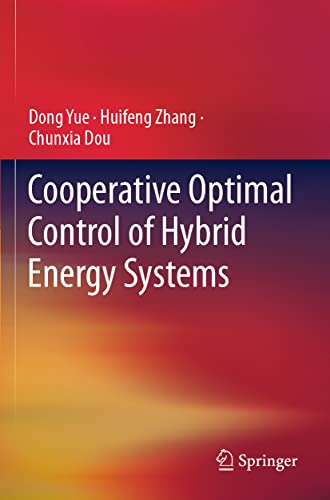
Cooperative optimal control of hybrid energy systems
Language: English Publication details: Singapore: Springer, 2021. Edition: 1st edDescription: xvi, 372p.; 21cmsISBN: 9789813367241Subject(s): Renewable energy sources | Renewable resource integration | Electric power distribution--Automation | Hybrid power systems | Automatic controlDDC classification: 621.3121 Y84, 1| Item type | Current library | Call number | Status | Date due | Barcode |
|---|---|---|---|---|---|
 Books
Books
|
Dr. S. R. Ranganathan Library General Stacks | 621.3121 Y84, 1 (Browse shelf(Opens below)) | Available | 2830 |
Browsing Dr. S. R. Ranganathan Library shelves, Shelving location: General Stacks Close shelf browser (Hides shelf browser)

|
|

|

|

|

|

|
||
| 621.3121 E44, 2:2 Standard handbook of powerplant engineering | 621.3121 E44, 2:3 Standard handbook of powerplant engineering | 621.3121 K49 Integration of green and renewable energy in electric power systems | 621.3121 Y84, 1 Cooperative optimal control of hybrid energy systems | 621.312136 A53 Wind turbines: theory and practice | 621.312136 J43 Wind turbine technology | 621.312136 M36, 2 Wind energy explained: theory, design and application |
This book mainly investigates the cooperative optimal control of hybrid energy system, it presents security control, multi-objective optimization, distributed optimization and distributed control approaches for tackling with security, economic and stability problem of the hybrid energy system.
It aims to solve some challenging problems including security issue, economic cost or benefits from both power generation side and load demand side, and coordination among different power generators.
The methods proposed in this book is novel and attractive, it consists of the hierarchical optimal control strategy for the security issue, multi-objective optimization for both economic and emission issue, and distributed optimal control for coordination among power generators.
Readers can learn novel methods or technique for tackling with the security issue, multiple-objective problem, and distributed coordination problem. It also may inspire readers to improve some drawbacks of existing alternatives.
Some fundamental knowledge prepared to read this book includes basic principles of the multi-agents system, robust optimization, Pareto-dominance optimization, and background of electrical engineering and renewable energy.